Global Medevac Flights with AvSky

On-Demand Air Ambulance & Medical Flight Services

AvSky provides full-service, end-to-end medical flight services, including coordination of the in-flight medical team and emergency ground transportation when required.

The AvSky Charters Difference…
  • Access to specialized medical aircraft.
    From medevac helicopters to long-range jets configured for ICU-level care.
  • A network of flight nurses.
    Critical-care nurses and paramedics, available at a moment’s notice.
  • International repatriation.
    Bringing patients home from abroad — permits, customs, and cross-border care, coordinated.
  • Neonatal and pediatric transport.
    Transport incubators and specialist crews for newborns and children.
  • Insurance and billing support.
    Help working with your insurer or assistance plan, with claim-ready paperwork.

Submit the quote request form or call our team at (800) 541-0381 to speak with us immediately.

Worldwide · Emergency or Advance

Request an Air Ambulance Quote

Select date
SMTWTFS
Emergency / critical-care
ICU / ventilator
Stretcher / non-emergency
Neonatal / pediatric
Medical escort
Not sure — advise me
US+1
US+1
CA+1
MX+52
GB+44
DE+49
FR+33
ES+34
IT+39
AE+971
AU+61
JP+81
BR+55
IN+91
Please add your name, email, and phone so we can reach you.
Request received

We’ve got it

An AvSky Charters advisor will call or email you to confirm details and provide your quote.

Your details
← Send another
Part 135vetted operators
Worldwidedomestic & intl
Same-dayquotes & plans
One teamstart to finish

Fully Managed Medical Flights From First-Call to Wheels Down

When it comes to medical flights, minutes matter and mistakes or delays can be devastating. From your first call or email, our highly-experienced private aviation team takes ownership of this critical mission, coordinating transfer logistics and paperwork, anticipating problems before they arise, making the right calls under pressure, and keeping you informed every step of the way.
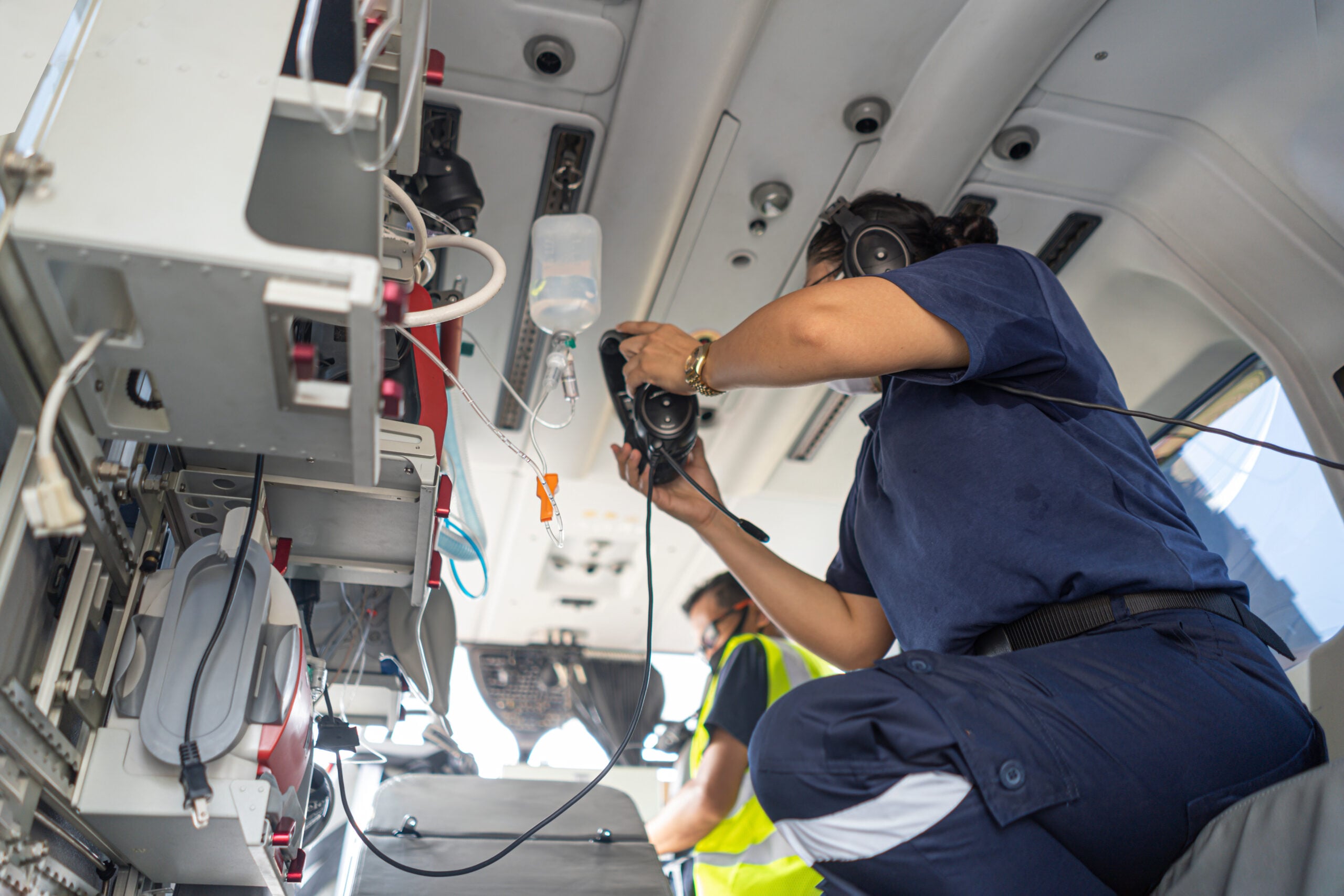
Flight nurse tending to medical equipment aboard an air ambulance cabin
The Fleet

Air ambulance aircraft

Drawing on a broad network of vetted operators, we find the aircraft that best balances safety, patient comfort, and cost for each mission. Tell us what matters most for your situation, and we’ll work to find the right fit.

Light Jet · ICU
Embraer Phenom 300MED
Embraer’s factory medevac light jet — a flying ICU on the world’s best-selling light jet, fast and efficient for domestic and regional missions.
Light Jet · Short-field
Pilatus PC-24 Air Ambulance
A purpose-built medevac jet with a patient door and electric stretcher lift, plus the short-runway reach of a turboprop.
Mid Jet · ICU
Bombardier Learjet 35 / 45
The classic air-ambulance jet, configured as a flying ICU — fast, proven, with a wide door for easy stretcher loading.
Heavy Jet · Long-range
Bombardier Challenger 650
A large-cabin medevac jet for long-range, intercontinental repatriation, with room for a full ICU and a companion.
Heavy Jet · Ultra-long
Gulfstream G550
An ultra-long-range medevac jet for nonstop intercontinental repatriation, with a large cabin equipped to full ICU standard.
Turboprop · Short-field
Beechcraft King Air 360
A medevac-configured twin turboprop that reaches the smaller airports and shorter runways closest to the patient.
Helicopter · EMS
Airbus H145
A twin-engine EMS helicopter with a large cabin for up to two stretchers, quiet enough for hospital-helipad operations.
Helicopter · HEMS
Leonardo AW169
A modern HEMS helicopter with a spacious cabin, purpose-designed for emergency medical missions and scene response.
Capabilities

Air ambulance services for every situation

From a critical-care evacuation to a planned hospital transfer, we arrange the right aircraft, crew, and equipment for the mission.

Emergency Air Ambulance

A fully-equipped ICU in the air for critically ill or injured patients — a critical-care team and advanced life support, matched to the patient’s condition.

Non-Emergency Medical Transfers

Planned transfers handled with the same care: moving a patient to a specialized center or between facilities, on your timeline.

ICU & Critical-Care Transport

For the most fragile patients — ventilator support, continuous monitoring, and intensive-care-level care from bedside to bedside.

Neonatal & Pediatric Transport

Specialized teams and equipment, including transport incubators, for newborns and children who need the gentlest possible care.

Stretcher Flights

Aircraft configured for a secured medical stretcher, with the team and equipment to care for patients who can’t sit upright.

Organ & Time-Critical Transport

Fast, dedicated charters for transplant teams and time-sensitive medical cargo, built around tight clinical windows.

48 Hours of Action
ROM → TPA
Bedside pickup
Private ambulance to the Rome ramp
Medical crew
Flight nurse, ICU-equipped cabin
The crossing
Permits and customs precleared
Ground handoff
Ambulances staged on both ends
Bedside delivery
Straight to the receiving hospital
Proven When It Counts

An International Medical Transfer

When a longtime client needed a family member moved internationally for urgent medical care, the clock was already running. Our team flew a critical-care nurse to Rome, equipped the aircraft to ICU standard, and coordinated directly with the sending hospital, then arranged private ambulances and ground transport for the family on both ends. We cleared the international permits and operational hurdles that stop most operators cold — and got the patient home to the care they needed.

This is the kind of mission we’re built for.

The AvSky Charters team in Venice, Florida
Meet the Team

A dedicated team behind every flight.

The AvSky team is based in Venice, Florida. We’re available around the clock and ready to coordinate every detail of your medical flight — the aircraft, the medical crew, and the ground teams on both ends.

About AvSky Charters
Cost & Insurance

What it costs, and how we help

Air ambulance costs depend on distance, the aircraft, and the level of medical care — a short domestic transfer is a very different figure from an intercontinental ICU flight. We give you a clear, all-in quote fast. And because paying for a medical flight is rarely simple, we help you work with your insurer or assistance plan and provide the documentation your claim needs.

1
A clear, all-in quote

One price, fast — aircraft, crew, equipment, and ground, with nothing hidden.

2
Insurer & assistance coordination

We help you work with your insurer or medical-assistance plan throughout.

3
Claim-ready documentation

The records and medical-necessity paperwork your claim needs, prepared for you.

Questions

Air ambulance FAQs

What is an air ambulance?
An air ambulance — also called a medevac — is an aircraft configured and equipped to carry a patient under full medical care, functioning as an intensive care unit in the air. It's staffed by a critical-care medical team and stocked with hospital-grade equipment: a transport ventilator, a cardiac monitor, a defibrillator, infusion pumps, oxygen, and suction. Air ambulances come as fixed-wing aircraft — jets and turboprops for longer distances — and as helicopters for short, time-critical flights. They carry patients too ill or injured to fly commercially, from critical emergencies to stable, planned transfers. We arrange the right aircraft and medical team for each patient's condition and the distance to be flown.
How fast can you arrange an air ambulance?
For urgent domestic missions, we can often have a medically-equipped aircraft and crew moving within hours of your call — the time it takes to source and position the aircraft, assemble the medical team, and complete a fit-to-fly assessment. International missions typically take longer, frequently 24 to 48 hours or more, because of overflight and landing permits for each country on the route, customs and immigration clearance, crew duty and rest limits, receiving-hospital coordination, and any fuel stops. A patient in a remote location can add time if an aircraft has to reposition. The single biggest factor is when you call — reaching us early, even before a flight is confirmed, lets us line everything up while the patient is stable.
How much does an air ambulance cost?
It depends on four things: distance (most flights are priced as a base fee plus loaded miles), the aircraft (a turboprop for a short regional hop costs far less than a jet), the level of medical care (a standard critical-care team versus a flight requiring a physician, a ventilator, and specialized equipment), and repositioning if the nearest suitable aircraft has to fly empty to reach the patient. As a general guide, domestic flights commonly run from around $12,000 for a short transfer to $50,000–$100,000 or more for a long cross-country mission with an ICU-level team. We give you a clear, all-in quote before anything is booked, and most providers require payment or a guarantee of payment before the aircraft is dispatched.
How much does an international air ambulance flight cost?
International missions cost more because of the distance, overflight and landing permits, ground handling, fuel stops, and crew requirements. An intercontinental flight with a critical-care team commonly ranges from roughly $80,000 to $200,000 or more, and the longest transoceanic missions — from Asia or Australia to the United States, for example — can run higher still. The aircraft drives much of the figure: crossing oceans calls for a super-midsize or heavy jet with the range to fly with minimal stops. We price each mission individually, factor in the permits and handling from the outset, and tell you exactly what the quote includes so there are no surprises later.
Does Medicare cover air ambulance costs?
Medicare Part B covers emergency air ambulance transport when it's medically necessary and ground transport would endanger the patient, taking them to the nearest appropriate facility that can provide the required care. You're typically responsible for 20% of the Medicare-approved amount after meeting the Part B deductible. Non-emergency air transport can be covered but generally requires prior authorization and documentation of medical necessity. Importantly, Medicare almost never covers transport outside the United States, so it usually can't be relied on to bring a patient home from abroad. We provide the medical and flight documentation you'll need to support a Medicare claim.
Does health insurance cover air ambulance flights?
Sometimes, in whole or in part — it depends on your plan, and coverage is inconsistent. Private insurers may cover a medically necessary air ambulance subject to your deductible and coinsurance, though historically a large share of transports ended up out of network. The federal No Surprises Act now protects you from balance billing on covered air ambulance flights, so you pay only your in-network cost-sharing — but it doesn't guarantee your plan will cover the flight, and it doesn't apply to ground ambulance. Medicaid covers air ambulance in many states, with rules that vary. For international trips, standard insurance rarely pays; travel medical insurance and medical evacuation memberships are far more reliable. We coordinate the flight and provide everything your claim needs.
How do I pay for an air ambulance, and when?
Air ambulance providers generally require payment or a documented guarantee of payment before the aircraft is dispatched — standard across the industry, and especially for international missions. Families typically pay one of a few ways: directly out of pocket, through a travel medical insurance policy that bills the provider, through a medical evacuation membership, or with a guarantee of payment issued by an insurer that has authorized the transport. We help you pull together what's needed to secure a guarantee of payment quickly, so it doesn't delay an urgent flight, and afterward we provide the itemized documentation you'll need to seek reimbursement from your insurer.
Can the patient fly with their condition?
That's a clinical decision, made by a flight physician — not by us and not by you. The physician reviews the patient's medical records and usually speaks directly with the treating doctor to confirm the patient is stable enough to fly and to determine the level of in-flight care required. The great majority of conditions can be transported safely with the right team and equipment — including ventilated, post-cardiac, stroke, trauma, and high-risk obstetric patients. Some conditions are sensitive to cabin pressure and altitude, such as a pneumothorax or recent surgery, which the team manages with altitude restrictions or a sea-level cabin. Occasionally the recommendation is to stabilize first, then fly. We arrange this assessment as part of the process.
Can you transport a patient on a ventilator or life support?
Yes — ventilated and critically ill patients are core to what an air ambulance does. These missions use a transport ventilator, continuous monitoring, and a critical-care team that, depending on the patient, includes a critical-care nurse, a flight paramedic, and often a respiratory therapist or physician. The aircraft carries independent power and oxygen supplies to sustain the equipment throughout the flight, and can support patients on multiple medication drips, an intra-aortic balloon pump, and other advanced life support. The flight physician confirms the patient is fit to fly and configures the team and equipment to match. We source operators and clinical teams equipped for this level of care.
Is there a doctor on board, and who's on the medical team?
The medical team is built around how sick the patient is. For most patients, the right team is a critical-care flight nurse and a flight paramedic, trained in flight physiology and equipped to deliver ICU-level care in the air. A physician and, where needed, a respiratory therapist are added for the most complex cases — ventilated patients, balloon-pump support, or unstable critical care. Every team is matched to the patient's condition rather than assigned from a fixed package. We source medical crews and accredited providers — including those accredited by bodies such as CAMTS — appropriate to each mission, so the clinicians in the cabin have exactly the training and equipment the situation demands.
What medical equipment is on board an air ambulance?
An air ambulance carries the equipment of a hospital intensive care unit, adapted for flight. That typically includes a transport ventilator, a multi-parameter cardiac monitor (tracking heart rhythm, oxygen saturation, blood pressure, and often end-tidal CO2), a defibrillator, infusion and syringe pumps for continuous medications, and onboard oxygen and suction. The aircraft supplies independent power and medical-grade oxygen so everything runs reliably from bedside to bedside. More specialized missions add equipment such as a neonatal transport incubator, an intra-aortic balloon pump, or extended pharmacy supplies. The exact configuration is matched to the patient's condition, and the medical team confirms it's all in place before departure.
Do you provide neonatal and pediatric air ambulance transport?
Yes. Newborns and children need specialized teams and equipment, and we arrange both. Neonatal missions use a transport incubator, or isolette, and where needed a neonatal ventilator, staffed by teams experienced in NICU-level care. Pediatric transports are configured with appropriately sized equipment and clinicians trained to care for young patients in flight. Because these missions are specialized, we source operators and medical crews with genuine neonatal and pediatric experience rather than a general critical-care team. As with every mission, a physician confirms the child is fit to fly and sets the composition of the team and the equipment onboard.
What's the difference between an air ambulance and a medical escort?
An air ambulance is a dedicated, medically-configured aircraft — effectively a flying ICU with a critical-care team and advanced equipment — for patients who are unstable, critical, or need close monitoring. A medical escort is a nurse or paramedic who accompanies a stable patient on a scheduled commercial flight, carrying portable oxygen and equipment, and in some cases arranging a stretcher where the airline permits. A medical escort costs far less but suits a narrower range of patients, and it's often a good fit for a stable patient on a long international route. Which option is appropriate isn't a budget decision — the medical team determines what's safe — and we arrange whichever the patient's condition calls for.
Can you coordinate the hospitals and ground ambulances on both ends?
Yes — this is the bedside-to-bedside coordination we handle on most missions. We arrange the ground ambulance from the sending hospital to the aircraft, the medical care in the air, and the ground ambulance from the aircraft to the receiving hospital, with the medical team managing a proper clinical handoff — a full patient report and transfer of records — at each end. For international transfers we also coordinate directly with the receiving facility so a bed and the right team are ready, and we handle customs and immigration clearance on arrival. The goal is a single, unbroken chain of care, with no point where you're left to arrange the next leg yourself.
Can someone travel with the patient?
Usually, yes. Most air ambulances have room for at least one family member or companion to travel with the patient, and larger jets often seat more. The number of seats depends on the aircraft, the medical equipment onboard, and the medical team's requirements — on a smaller light jet or turboprop configured for full critical care, space can be limited, while a super-midsize or heavy jet typically has more room. Being there matters, especially on a long international flight, and we work to make it possible. We confirm exactly how many companion seats are available when we build the flight plan, and for international trips we'll flag any passport or visa requirements.
What aircraft do you use for air ambulance flights?
We match the aircraft to the mission, the distance, and the runway. For domestic and regional transfers and short or unpaved fields, that often means a medically-configured light jet such as the Phenom 300MED, or a turboprop like the King Air 350 or Pilatus PC-12. For long-range and international repatriation, we use super-midsize and heavy jets such as the Challenger 650 or Gulfstream G550, which have the range to cross oceans with a full ICU aboard. For short, time-critical flights and scene response, we arrange EMS helicopters such as the Airbus H145 or Leonardo AW169. Every aircraft is medically configured with the equipment the patient's condition requires — you can see the full lineup in the aircraft grid above.

Ready to arrange an air ambulance?

Speak with a flight coordinator about your mission — emergency or planned, domestic or international.

AvSky Charters · 400 Airport Ave E, Venice, FL 34285
Global Medevac · Emergency or advance

On-Demand Air Ambulance & Medical Flight Services

AvSky provides full-service, end-to-end medical flight services, including coordination of the in-flight medical team and emergency ground transportation when required.

Part 135vetted operators
Worldwidedomestic & intl
Same-dayquotes & plans
One teamstart to finish
The AvSky Charters Difference…
  • Access to specialized medical aircraft.
    From medevac helicopters to long-range jets configured for ICU-level care.
  • A network of flight nurses.
    Critical-care nurses and paramedics, available at a moment’s notice.
  • International repatriation.
    Bringing patients home from abroad — permits, customs, and cross-border care, coordinated.
  • Neonatal and pediatric transport.
    Transport incubators and specialist crews for newborns and children.
  • Insurance and billing support.
    Help working with your insurer or assistance plan, with claim-ready paperwork.
Worldwide · 24/7

Request an Air Ambulance

Select date
SMTWTFS
Emergency / critical-care
ICU / ventilator
Stretcher / non-emergency
Neonatal / pediatric
Medical escort
Not sure — advise me
US+1
US+1
CA+1
MX+52
GB+44
DE+49
FR+33
ES+34
IT+39
AE+971
AU+61
JP+81
BR+55
IN+91
Please add your name, email, and phone so we can reach you.
Request received

We’ve got it

A flight coordinator will call or email you to confirm details and provide your quote.

Your details
← Send another

Fully Managed Medical Flights From First-Call to Wheels Down

When it comes to medical flights, minutes matter and mistakes or delays can be devastating. From your first call or email, our highly-experienced private aviation team takes ownership of this critical mission, coordinating transfer logistics and paperwork, anticipating problems before they arise, making the right calls under pressure, and keeping you informed every step of the way.

Flight nurse tending to medical equipment aboard an air ambulance cabin
The Fleet

Air ambulance aircraft

Capabilities

Services for every situation

Emergency Air Ambulance

A fully-equipped ICU in the air, with a critical-care team matched to the patient’s condition.

Non-Emergency Medical Transfers

Planned transfers handled with the same care, on your timeline.

ICU & Critical-Care Transport

Ventilator support and continuous monitoring, bedside to bedside.

Neonatal & Pediatric Transport

Transport incubators and specialist crews for newborns and children.

Stretcher Flights

Aircraft configured for a secured medical stretcher and full in-flight care.

Organ & Time-Critical Transport

Dedicated charters built around tight clinical windows.

Proven When It Counts

An International Medical Transfer

48 Hours of Action
ROM → TPA
Bedside pickup
Private ambulance to the Rome ramp
Medical crew
Flight nurse, ICU-equipped cabin
The crossing
Permits and customs precleared
Ground handoff
Ambulances staged on both ends
Bedside delivery
Straight to the receiving hospital

When a longtime client needed a family member moved internationally for urgent medical care, the clock was already running. Our team flew a critical-care nurse to Rome, equipped the aircraft to ICU standard, and coordinated directly with the sending hospital, then arranged private ambulances and ground transport for the family on both ends. We cleared the international permits and operational hurdles that stop most operators cold — and got the patient home to the care they needed.

This is the kind of mission we’re built for.

Meet the Team

A dedicated team behind every flight.

The AvSky Charters team in Venice, Florida

The AvSky team is based in Venice, Florida. We’re available around the clock and ready to coordinate every detail of your medical flight — the aircraft, the medical crew, and the ground teams on both ends.

About AvSky Charters
Cost & Insurance

What it costs, and how we help

1
A clear, all-in quote

One price, fast — aircraft, crew, equipment, and ground, with nothing hidden.

2
Insurer & assistance coordination

We help you work with your insurer or medical-assistance plan throughout.

3
Claim-ready documentation

The records and medical-necessity paperwork your claim needs, prepared for you.

Questions

Air ambulance FAQs

What is an air ambulance?
An air ambulance — also called a medevac — is an aircraft configured and equipped to carry a patient under full medical care, functioning as an intensive care unit in the air. It's staffed by a critical-care medical team and stocked with hospital-grade equipment: a transport ventilator, a cardiac monitor, a defibrillator, infusion pumps, oxygen, and suction. Air ambulances come as fixed-wing aircraft — jets and turboprops for longer distances — and as helicopters for short, time-critical flights. They carry patients too ill or injured to fly commercially, from critical emergencies to stable, planned transfers. We arrange the right aircraft and medical team for each patient's condition and the distance to be flown.
How fast can you arrange an air ambulance?
For urgent domestic missions, we can often have a medically-equipped aircraft and crew moving within hours of your call — the time it takes to source and position the aircraft, assemble the medical team, and complete a fit-to-fly assessment. International missions typically take longer, frequently 24 to 48 hours or more, because of overflight and landing permits for each country on the route, customs and immigration clearance, crew duty and rest limits, receiving-hospital coordination, and any fuel stops. A patient in a remote location can add time if an aircraft has to reposition. The single biggest factor is when you call — reaching us early, even before a flight is confirmed, lets us line everything up while the patient is stable.
How much does an air ambulance cost?
It depends on four things: distance (most flights are priced as a base fee plus loaded miles), the aircraft (a turboprop for a short regional hop costs far less than a jet), the level of medical care (a standard critical-care team versus a flight requiring a physician, a ventilator, and specialized equipment), and repositioning if the nearest suitable aircraft has to fly empty to reach the patient. As a general guide, domestic flights commonly run from around $12,000 for a short transfer to $50,000–$100,000 or more for a long cross-country mission with an ICU-level team. We give you a clear, all-in quote before anything is booked, and most providers require payment or a guarantee of payment before the aircraft is dispatched.
How much does an international air ambulance flight cost?
International missions cost more because of the distance, overflight and landing permits, ground handling, fuel stops, and crew requirements. An intercontinental flight with a critical-care team commonly ranges from roughly $80,000 to $200,000 or more, and the longest transoceanic missions — from Asia or Australia to the United States, for example — can run higher still. The aircraft drives much of the figure: crossing oceans calls for a super-midsize or heavy jet with the range to fly with minimal stops. We price each mission individually, factor in the permits and handling from the outset, and tell you exactly what the quote includes so there are no surprises later.
Does Medicare cover air ambulance costs?
Medicare Part B covers emergency air ambulance transport when it's medically necessary and ground transport would endanger the patient, taking them to the nearest appropriate facility that can provide the required care. You're typically responsible for 20% of the Medicare-approved amount after meeting the Part B deductible. Non-emergency air transport can be covered but generally requires prior authorization and documentation of medical necessity. Importantly, Medicare almost never covers transport outside the United States, so it usually can't be relied on to bring a patient home from abroad. We provide the medical and flight documentation you'll need to support a Medicare claim.
Does health insurance cover air ambulance flights?
Sometimes, in whole or in part — it depends on your plan, and coverage is inconsistent. Private insurers may cover a medically necessary air ambulance subject to your deductible and coinsurance, though historically a large share of transports ended up out of network. The federal No Surprises Act now protects you from balance billing on covered air ambulance flights, so you pay only your in-network cost-sharing — but it doesn't guarantee your plan will cover the flight, and it doesn't apply to ground ambulance. Medicaid covers air ambulance in many states, with rules that vary. For international trips, standard insurance rarely pays; travel medical insurance and medical evacuation memberships are far more reliable. We coordinate the flight and provide everything your claim needs.
How do I pay for an air ambulance, and when?
Air ambulance providers generally require payment or a documented guarantee of payment before the aircraft is dispatched — standard across the industry, and especially for international missions. Families typically pay one of a few ways: directly out of pocket, through a travel medical insurance policy that bills the provider, through a medical evacuation membership, or with a guarantee of payment issued by an insurer that has authorized the transport. We help you pull together what's needed to secure a guarantee of payment quickly, so it doesn't delay an urgent flight, and afterward we provide the itemized documentation you'll need to seek reimbursement from your insurer.
Can the patient fly with their condition?
That's a clinical decision, made by a flight physician — not by us and not by you. The physician reviews the patient's medical records and usually speaks directly with the treating doctor to confirm the patient is stable enough to fly and to determine the level of in-flight care required. The great majority of conditions can be transported safely with the right team and equipment — including ventilated, post-cardiac, stroke, trauma, and high-risk obstetric patients. Some conditions are sensitive to cabin pressure and altitude, such as a pneumothorax or recent surgery, which the team manages with altitude restrictions or a sea-level cabin. Occasionally the recommendation is to stabilize first, then fly. We arrange this assessment as part of the process.
Can you transport a patient on a ventilator or life support?
Yes — ventilated and critically ill patients are core to what an air ambulance does. These missions use a transport ventilator, continuous monitoring, and a critical-care team that, depending on the patient, includes a critical-care nurse, a flight paramedic, and often a respiratory therapist or physician. The aircraft carries independent power and oxygen supplies to sustain the equipment throughout the flight, and can support patients on multiple medication drips, an intra-aortic balloon pump, and other advanced life support. The flight physician confirms the patient is fit to fly and configures the team and equipment to match. We source operators and clinical teams equipped for this level of care.
Is there a doctor on board, and who's on the medical team?
The medical team is built around how sick the patient is. For most patients, the right team is a critical-care flight nurse and a flight paramedic, trained in flight physiology and equipped to deliver ICU-level care in the air. A physician and, where needed, a respiratory therapist are added for the most complex cases — ventilated patients, balloon-pump support, or unstable critical care. Every team is matched to the patient's condition rather than assigned from a fixed package. We source medical crews and accredited providers — including those accredited by bodies such as CAMTS — appropriate to each mission, so the clinicians in the cabin have exactly the training and equipment the situation demands.
What medical equipment is on board an air ambulance?
An air ambulance carries the equipment of a hospital intensive care unit, adapted for flight. That typically includes a transport ventilator, a multi-parameter cardiac monitor (tracking heart rhythm, oxygen saturation, blood pressure, and often end-tidal CO2), a defibrillator, infusion and syringe pumps for continuous medications, and onboard oxygen and suction. The aircraft supplies independent power and medical-grade oxygen so everything runs reliably from bedside to bedside. More specialized missions add equipment such as a neonatal transport incubator, an intra-aortic balloon pump, or extended pharmacy supplies. The exact configuration is matched to the patient's condition, and the medical team confirms it's all in place before departure.
Do you provide neonatal and pediatric air ambulance transport?
Yes. Newborns and children need specialized teams and equipment, and we arrange both. Neonatal missions use a transport incubator, or isolette, and where needed a neonatal ventilator, staffed by teams experienced in NICU-level care. Pediatric transports are configured with appropriately sized equipment and clinicians trained to care for young patients in flight. Because these missions are specialized, we source operators and medical crews with genuine neonatal and pediatric experience rather than a general critical-care team. As with every mission, a physician confirms the child is fit to fly and sets the composition of the team and the equipment onboard.
What's the difference between an air ambulance and a medical escort?
An air ambulance is a dedicated, medically-configured aircraft — effectively a flying ICU with a critical-care team and advanced equipment — for patients who are unstable, critical, or need close monitoring. A medical escort is a nurse or paramedic who accompanies a stable patient on a scheduled commercial flight, carrying portable oxygen and equipment, and in some cases arranging a stretcher where the airline permits. A medical escort costs far less but suits a narrower range of patients, and it's often a good fit for a stable patient on a long international route. Which option is appropriate isn't a budget decision — the medical team determines what's safe — and we arrange whichever the patient's condition calls for.
Can you coordinate the hospitals and ground ambulances on both ends?
Yes — this is the bedside-to-bedside coordination we handle on most missions. We arrange the ground ambulance from the sending hospital to the aircraft, the medical care in the air, and the ground ambulance from the aircraft to the receiving hospital, with the medical team managing a proper clinical handoff — a full patient report and transfer of records — at each end. For international transfers we also coordinate directly with the receiving facility so a bed and the right team are ready, and we handle customs and immigration clearance on arrival. The goal is a single, unbroken chain of care, with no point where you're left to arrange the next leg yourself.
Can someone travel with the patient?
Usually, yes. Most air ambulances have room for at least one family member or companion to travel with the patient, and larger jets often seat more. The number of seats depends on the aircraft, the medical equipment onboard, and the medical team's requirements — on a smaller light jet or turboprop configured for full critical care, space can be limited, while a super-midsize or heavy jet typically has more room. Being there matters, especially on a long international flight, and we work to make it possible. We confirm exactly how many companion seats are available when we build the flight plan, and for international trips we'll flag any passport or visa requirements.
What aircraft do you use for air ambulance flights?
We match the aircraft to the mission, the distance, and the runway. For domestic and regional transfers and short or unpaved fields, that often means a medically-configured light jet such as the Phenom 300MED, or a turboprop like the King Air 350 or Pilatus PC-12. For long-range and international repatriation, we use super-midsize and heavy jets such as the Challenger 650 or Gulfstream G550, which have the range to cross oceans with a full ICU aboard. For short, time-critical flights and scene response, we arrange EMS helicopters such as the Airbus H145 or Leonardo AW169. Every aircraft is medically configured with the equipment the patient's condition requires — you can see the full lineup in the aircraft grid above.

Ready to arrange a flight?

Speak with a flight coordinator — emergency or planned, anywhere in the world.

Call (800) 541-0381
400 Airport Ave E, Venice, FL 34285