Charter Flights to Cancún, Mexico
Bypass commercial congestion at Mexico's busiest hub, clearing dedicated VIP customs before heading directly to Mayakoba resort enclaves.
Private FBO tarmac · 24/7 VIP handlingFly Private to Cancún & the Riviera Maya
Serving as the undisputed gateway to the Mexican Caribbean, Cancún balances high-energy coastal excitement with ultra-luxury seclusion along the Riviera Maya. Just south of the city, exclusive resort sanctuaries like Mayakoba weave private villas through emerald mangrove lagoons and white-sand beaches. Farther south, private beach retreats across Maroma Beach, Puerto Morelos and Playa del Carmen offer sophisticated hospitality, world-class golf and oceanfront wellness.
Flying private into the Mexican Caribbean bypasses crowded international terminals, clearing customs in a calm private FBO lounge. Average flight times run just over ninety minutes from Texas and Florida, with pre-arranged executive chauffeurs escorting you directly to Mayakoba or Riviera Maya estates.
Schedule Your Private Flight to Cancún
Private air travel to Cancún eliminates crowded commercial terminals and long customs queues, delivering you straight to your resort hours ahead of commercial passengers. AvSky Charters matches your group with an aircraft suited for fast nonstop performance. We secure airport parking, oversee VIP border clearance and arrange private executive chauffeur transit directly to your Mayakoba or Riviera Maya villa.
Sample round-trip estimates to Cancún, Mexico
These estimates price modeled round trips from major departure points, but AvSky Charters operates from any private airfield you select. Final charter rates reflect chosen aircraft class, passenger count, seasonal positioning and local airport handling. Every quote is delivered as a firm, all-inclusive number with all Mexican aviation fees included.
Price your specific trip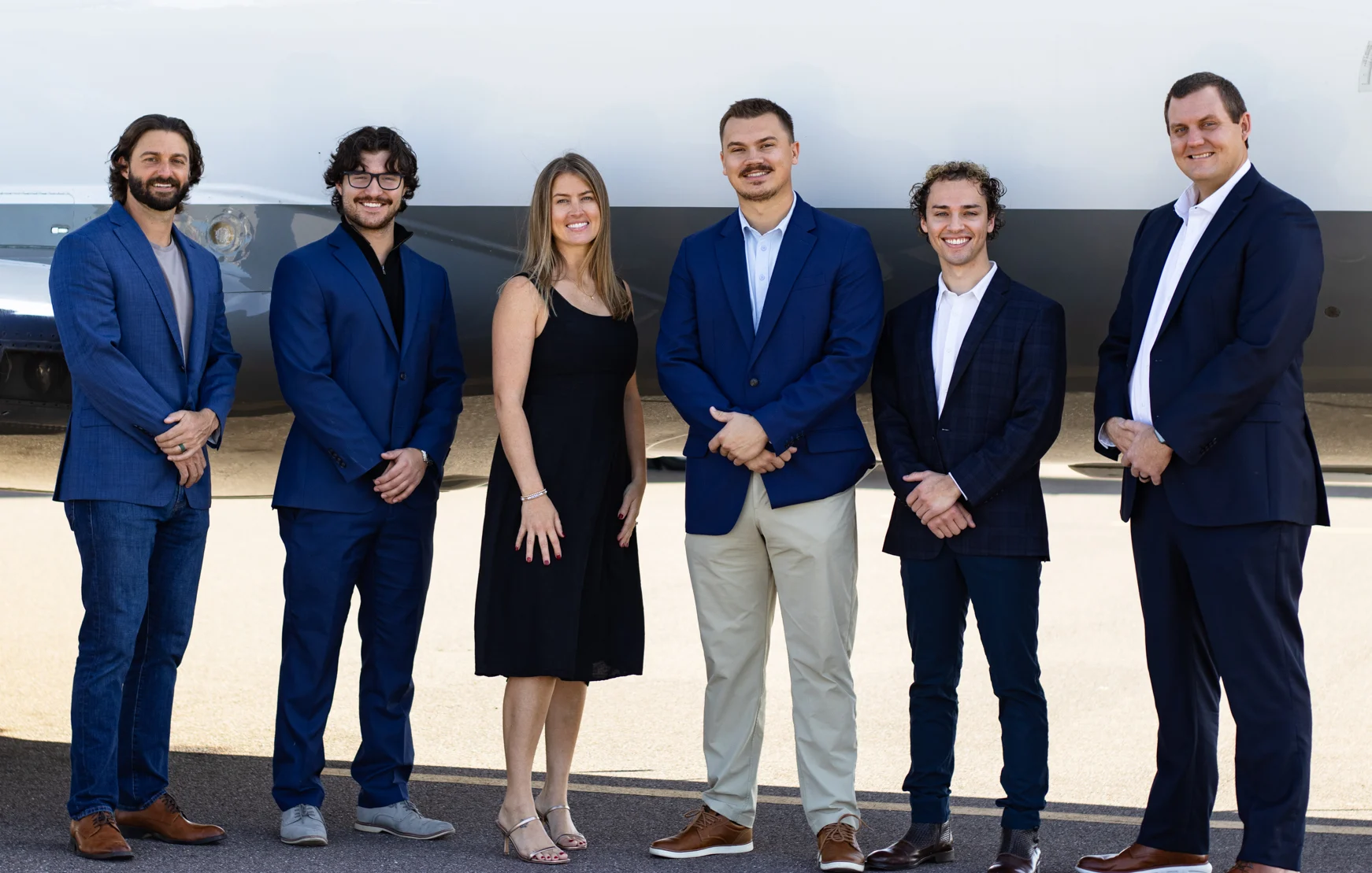 The AvSky Charters Leadership Team
Charter With The Best
AvSky provides comprehensive trip management on every flight, with rigorous operator vetting, route-appropriate aircraft selection, and coordinated ground transport upon request. The result is a seamless, fully white-glove charter experience from first call to wheels down.
Need catering, resort coordination or private security? Our charter advisors have the extensive experience and global partnerships necessary to provide a truly bespoke travel experience.
Cancún International: The Riviera Maya's 24-Hour Jet Gateway
Cancún International Airport (CUN/MMUN) serves as the primary aviation hub for the Yucatán Peninsula, situated ten miles south of downtown Cancún. The airport features parallel paved asphalt runways measuring 11,483 feet and 9,186 feet, easily accommodating the full spectrum of private aircraft up to transatlantic heavy jets. The airfield operates around the clock with full instrument approach systems.
Private aviation arrivals process through the airport's standalone FBO terminal, completely segregated from commercial passenger areas. The executive terminal offers comfortable passenger lounges, private customs and immigration processing, and secure ramp-side vehicle boarding. For travelers heading south toward Tulum, the new Felipe Carrillo Puerto International Airport provides an alternative gateway, while Cozumel offers regional diversion support.
Aircraft that can land at Cancún International Airport
Parallel 11,483 ft and 9,186 ft runways, 24 hours.
Mayakoba Luxury Enclave and Maroma Beach
The Riviera Maya coastline just south of Cancún contains some of Mexico's most celebrated luxury properties. The 620-acre Mayakoba enclave connects four premier resorts—Rosewood, Banyan Tree, Fairmont and Andaz—via tranquil freshwater lagoons where private electric boats ferry guests through mangrove canopies to white-sand oceanfront suites. Farther south, Maroma Beach features powder-soft coral sands and overwater bungalows, offering secluded relaxation along the gentle turquoise shallows of the Caribbean Sea.
Highways, Transit Times and Chauffeur Options
Navigating the Riviera Maya is fast and straightforward via Highway 307, the four-lane coastal corridor connecting Cancún southward through Playa del Carmen and Tulum. Driving times from the private FBO terminal run approximately 25 minutes to Puerto Morelos, 40 minutes to Mayakoba, and 75 minutes to southern coastal enclaves. AvSky Charters pre-arranges executive private chauffeur transfers in luxury SUVs directly from the tarmac, ensuring effortless transit straight to your suite.
Selecting Aircraft for Mexican Caribbean Corridors
Cancún's proximity to the United States makes it accessible across multiple aircraft categories. Light jets like the Phenom 300 or Citation CJ4 offer fast, cost-effective non-stop flights from Texas and Florida hubs. For departures from the Northeast, Midwest or West Coast, super-midsize and heavy jets like the Citation Sovereign, Challenger 350 or Gulfstream G450 provide spacious stand-up cabins, ample luggage room for golf clubs and non-stop transcontinental range.
Championship Golf and Underwater Caverns
Outdoor recreation across the Riviera Maya balances championship golf with ancient natural wonders. El Camaleón at Mayakoba, designed by Greg Norman, challenges golfers across oceanfront holes, mangrove canals and limestone cenotes. Inland, freshwater underground river systems create spectacular cenotes like Dos Ojos and Gran Cenote, where visitors snorkel and scuba dive through crystal-clear cavern waters framed by ancient stalactites and jungle vines.
Island Retreats and Coastal Escapes Beyond the Riviera Maya
Cozumel CZM
The island dive counterpart across the channel: the Mesoamerican Reef and drift walls.
Grand Cayman GCM
Seven Mile Beach, world-class wall diving, and George Town's offshore-finance heavyweight.
Providenciales PLS
Turks and Caicos and the pale sand of Grace Bay, the region's quiet upscale-beach standard.
Punta Cana PUJ
The Dominican Republic's marquee resort coast, a magnet for weddings and large-group travel.
Your Cancún Charter Questions, Answered
The run from South Florida is short — Miami's Opa-locka field (OPF) sits about 465 nautical miles from Cancún, typically a bit over 90 minutes in the air. The Texas markets come next: figure roughly two hours from Houston (HOU, near 690 nm) and a bit more from Dallas (DAL, about 890 nm). Farther-flung origins are still comfortable one-leg trips in the right aircraft — Chicago (PWK) is close to 1,265 nm and usually blocks in around three and a half hours, and Teterboro (TEB) outside New York runs a similar leg around 1,355 nm. Actual block time moves with routing, winds, and load, and most trips can be flown over the Gulf rather than through Cuban airspace — the operator confirms the filed route and nonstop feasibility.
For most Cancún and Riviera Maya trips the choice between the two airports comes down to the drive, not the runway — both are long, jet-capable fields, and your operator signs off on fit for the aircraft and load. Cancún is the pick for the hotel zone, the northern Riviera Maya, Mayakoba, and Playa del Carmen — commonly 30 minutes to an hour by road from those resorts, depending on the property and traffic. Tulum's airport, open since the end of 2023, sits about 40 minutes outside the town center, against a haul that can reach two hours out of Cancún, so it's the clear choice for the southern coast. Playa del Carmen falls close to the middle. We keep a separate page for Tulum charters; tell us the resort and we'll point you to the right field.
Private jets arriving in Cancún use the airport's dedicated general aviation terminal, well away from the airline halls, with your handler lining up the arrival with customs and immigration. The exact inspection flow — where it happens and how long it takes — gets confirmed for each trip rather than promised in advance, since staffing and documentation checks vary. Tulum's airport clears private arrivals at a facility of its own; Cozumel is a port of entry too, though current guidance has private flights there processed in the main passenger building, not at a separate FBO. U.S. travelers need a valid passport book — the card version won't do for flying — the immigration officer sets the authorized stay, other nationalities should check their own document rules, and VIP meet-and-assist can be added on request.
A Cancún charter needs lead time because it rides on the operator's Mexican paperwork, and the country has been stiffening its requirements. A foreign charter operator needs standing Mexican authority — current guidance describes an indefinite blanket permit tied to a validated air-operator certificate, a process best started months, not weeks, ahead — and Mexico has more recently been requiring flights to receive central approval from the aviation authority's head office, a step that's been slow and unevenly applied. Add the country's passenger-manifest filings in both directions, which come in two parts, plus the flight-plan and customs paperwork, and it's a genuine stack. None of it touches you as the passenger — AvSky and the operator manage the filings — but it's why a Cancún trip asks for more lead time than a domestic hop, and why a last-minute Mexican charter is tougher to pull together than most.
Usually, yes — most U.S.–Cancún routings can be planned across the Gulf of Mexico and the Yucatán without entering Cuban airspace, since the peninsula sits west of the island. The route your crew files is trip-specific, though: origin, weather, ATC, and the current airways all shape it, so the operator checks the assigned routing rather than assuming. If a flight does cross into Cuban airspace, then the applicable overflight permit and navigation fees get handled and included in the plan. Either way it's a simpler picture than a run to Grand Cayman or Jamaica, which sit on the far side of Cuba, where overflight approvals come into play far more often.
Every AvSky quote to Cancún is itemized, so you can see what the figure carries — the flight, the Mexican handling, the permits, and the taxes — and how each government charge is handled, including the ones Mexico collects per passenger. What moves the figure most is how big an aircraft the trip needs — the gap between a light cabin and a big one is the single biggest lever — and the class a route calls for depends on distance and how many are aboard. Winter holidays and spring break sit at the peak of the range; a departure city far from an available aircraft adds a ferry leg; and a packed winter ramp can mean paying to park the aircraft somewhere else between your flights. Mexico's per-person charges — the federal visitor fee and Quintana Roo's own tourism levy — are published figures your quote or your handler pins down at booking.
Empty legs do turn up on Cancún routes, since jets fly groups down and often reposition home with an empty cabin — but they're ad hoc, and one can change or vanish when the controlling itinerary moves. An empty leg trades certainty for price: you take the aircraft and the day that someone else's trip created, you pay noticeably less, and you accept that a change to their plans changes yours. For a traveler who can move a day either way, that's a fine bargain; for a fixed wedding weekend, a standard charter is the safer call. Send along the dates you'd consider and we'll flag any empty leg pointed at Cancún, set beside a normal quote so you can see the difference.
Luggage on a private jet to Cancún follows the aircraft you book, not an airline-style per-bag rule — though every flight still has real weight, balance, and volume limits the operator works to. As a rule of thumb, hold space grows with cabin class: a midsize or larger carries golf bags, dive kit, or a run of extra cases far more easily than a light jet, and the biggest cabins suit the heavy end — a wedding's dress bags and boxes of gifts, or a family's full week of luggage. Tell your coordinator the bag count, dimensions, and any oversize items early, and the aircraft gets chosen — and the final load approved — with all of it in mind.
Any month works for a trip to Cancún — the coast flies year-round — but two things reward a little timing. Peak weeks are the ones you'd expect: the winter holiday stretch, spring break, midsummer, when the ramp fills and handling slows, so arriving midweek or in a shoulder month usually makes for a calmer trip. Sargassum is the other factor: the seaweed shows up from April into October, though the amount and the beaches it lands on shift a lot from one year — and one week — to the next, so it's worth a look at current sargassum reports and a word with the resort ahead of picking dates. Neither changes whether you can fly; both are worth weighing before you commit.
Yes — a charter into Cancún builds easily into a multi-stop itinerary. Cozumel sits only about 30 nautical miles away, a quick jump for the reef and the dive walls, and if Tulum is on the plan, landing at its own field puts you 40 minutes or so from the middle of town instead of the long drive down Highway 307. Chichén Itzá and the cenotes are inland day trips by car from anywhere on the coast, and the whale-shark boats run out of Isla Mujeres through the summer. Tell us the full shape of the trip and we'll build the legs and the ground pieces so the connections actually line up.
Charter Flights to Cancún, Mexico
Sample round-trip estimates to Cancún, Mexico
These estimates price modeled round trips from major departure points, but AvSky Charters operates from any private airfield you select. Final charter rates reflect chosen aircraft class, passenger count, seasonal positioning and local airport handling. Every quote is delivered as a firm, all-inclusive number with all Mexican aviation fees included.
Get Instant EstimateFly Private to Cancún & the Riviera Maya
Serving as the undisputed gateway to the Mexican Caribbean, Cancún balances high-energy coastal excitement with ultra-luxury seclusion along the Riviera Maya. Just south of the city, exclusive resort sanctuaries like Mayakoba weave private villas through emerald mangrove lagoons and white-sand beaches. Farther south, private beach retreats across Maroma Beach, Puerto Morelos and Playa del Carmen offer sophisticated hospitality, world-class golf and oceanfront wellness.
Flying private into the Mexican Caribbean bypasses crowded international terminals, clearing customs in a calm private FBO lounge. Average flight times run just over ninety minutes from Texas and Florida, with pre-arranged executive chauffeurs escorting you directly to Mayakoba or Riviera Maya estates.
Schedule Your Private Flight to Cancún
Private air travel to Cancún eliminates crowded commercial terminals and long customs queues, delivering you straight to your resort hours ahead of commercial passengers. AvSky Charters matches your group with an aircraft suited for fast nonstop performance. We secure airport parking, oversee VIP border clearance and arrange private executive chauffeur transit directly to your Mayakoba or Riviera Maya villa.
Request An All-In QuoteCancún International: The Riviera Maya's 24-Hour Jet Gateway
Cancún International Airport (CUN/MMUN) serves as the primary aviation hub for the Yucatán Peninsula, situated ten miles south of downtown Cancún. The airport features parallel paved asphalt runways measuring 11,483 feet and 9,186 feet, easily accommodating the full spectrum of private aircraft up to transatlantic heavy jets. The airfield operates around the clock with full instrument approach systems.
Private aviation arrivals process through the airport's standalone FBO terminal, completely segregated from commercial passenger areas. The executive terminal offers comfortable passenger lounges, private customs and immigration processing, and secure ramp-side vehicle boarding. For travelers heading south toward Tulum, the new Felipe Carrillo Puerto International Airport provides an alternative gateway, while Cozumel offers regional diversion support.
Aircraft that can fly to & from Cancún International Airport
Parallel 11,483 ft and 9,186 ft runways, 24 hours.
Cancún, Mexico details.
Mayakoba Luxury Enclave and Maroma Beach
The Riviera Maya coastline just south of Cancún contains some of Mexico's most celebrated luxury properties. The 620-acre Mayakoba enclave connects four premier resorts—Rosewood, Banyan Tree, Fairmont and Andaz—via tranquil freshwater lagoons where private electric boats ferry guests through mangrove canopies to white-sand oceanfront suites. Farther south, Maroma Beach features powder-soft coral sands and overwater bungalows, offering secluded relaxation along the gentle turquoise shallows of the Caribbean Sea.
Highways, Transit Times and Chauffeur Options
Navigating the Riviera Maya is fast and straightforward via Highway 307, the four-lane coastal corridor connecting Cancún southward through Playa del Carmen and Tulum. Driving times from the private FBO terminal run approximately 25 minutes to Puerto Morelos, 40 minutes to Mayakoba, and 75 minutes to southern coastal enclaves. AvSky Charters pre-arranges executive private chauffeur transfers in luxury SUVs directly from the tarmac, ensuring effortless transit straight to your suite.
Selecting Aircraft for Mexican Caribbean Corridors
Cancún's proximity to the United States makes it accessible across multiple aircraft categories. Light jets like the Phenom 300 or Citation CJ4 offer fast, cost-effective non-stop flights from Texas and Florida hubs. For departures from the Northeast, Midwest or West Coast, super-midsize and heavy jets like the Citation Sovereign, Challenger 350 or Gulfstream G450 provide spacious stand-up cabins, ample luggage room for golf clubs and non-stop transcontinental range.
Championship Golf and Underwater Caverns
Outdoor recreation across the Riviera Maya balances championship golf with ancient natural wonders. El Camaleón at Mayakoba, designed by Greg Norman, challenges golfers across oceanfront holes, mangrove canals and limestone cenotes. Inland, freshwater underground river systems create spectacular cenotes like Dos Ojos and Gran Cenote, where visitors snorkel and scuba dive through crystal-clear cavern waters framed by ancient stalactites and jungle vines.
Four Operational Protocols for Cancún Charters
Complete International Entry Manifests in Advance
Private flights into Mexico require APIS passenger manifests filed well before departure, alongside aircraft landing permits. AvSky Charters coordinates all regulatory paperwork directly with Mexican civil aviation authorities, ensuring zero border delays upon arrival at the FBO.
Utilize the Standalone Private FBO Terminal
All general aviation flights land at Cancún's dedicated FBO, situated completely separate from commercial airline terminals. Arriving passengers enjoy private customs processing, quiet executive lounges and direct vehicle ramp access in under ten minutes.
Account for Peak Holiday Ramp Parking
During major holiday windows such as Thanksgiving, festive winter weeks and spring break, executive aircraft parking at Cancún can experience high demand. AvSky Charters confirms airport parking reservations well in advance to ensure your aircraft remains parked on-field.
Consider Tulum International for Southern Itineraries
For travelers staying in southern Riviera Maya enclaves or central Tulum, the new Tulum International Airport (TQO) provides an excellent alternative gateway, cutting highway travel times significantly compared to driving south from Cancún.
Island Retreats and Coastal Escapes Beyond the Riviera Maya
Your Cancún Charter Questions, Answered
Can we reach Cancún nonstop from our home airport?
The run from South Florida is short — Miami's Opa-locka field (OPF) sits about 465 nautical miles from Cancún, typically a bit over 90 minutes in the air. The Texas markets come next: figure roughly two hours from Houston (HOU, near 690 nm) and a bit more from Dallas (DAL, about 890 nm). Farther-flung origins are still comfortable one-leg trips in the right aircraft — Chicago (PWK) is close to 1,265 nm and usually blocks in around three and a half hours, and Teterboro (TEB) outside New York runs a similar leg around 1,355 nm. Actual block time moves with routing, winds, and load, and most trips can be flown over the Gulf rather than through Cuban airspace — the operator confirms the filed route and nonstop feasibility.
Which airport is better for our resort, Cancún or the new Tulum field?
For most Cancún and Riviera Maya trips the choice between the two airports comes down to the drive, not the runway — both are long, jet-capable fields, and your operator signs off on fit for the aircraft and load. Cancún is the pick for the hotel zone, the northern Riviera Maya, Mayakoba, and Playa del Carmen — commonly 30 minutes to an hour by road from those resorts, depending on the property and traffic. Tulum's airport, open since the end of 2023, sits about 40 minutes outside the town center, against a haul that can reach two hours out of Cancún, so it's the clear choice for the southern coast. Playa del Carmen falls close to the middle. We keep a separate page for Tulum charters; tell us the resort and we'll point you to the right field.
Does a private arrival at Cancún go through the airline terminal?
Private jets arriving in Cancún use the airport's dedicated general aviation terminal, well away from the airline halls, with your handler lining up the arrival with customs and immigration. The exact inspection flow — where it happens and how long it takes — gets confirmed for each trip rather than promised in advance, since staffing and documentation checks vary. Tulum's airport clears private arrivals at a facility of its own; Cozumel is a port of entry too, though current guidance has private flights there processed in the main passenger building, not at a separate FBO. U.S. travelers need a valid passport book — the card version won't do for flying — the immigration officer sets the authorized stay, other nationalities should check their own document rules, and VIP meet-and-assist can be added on request.
Why does a Cancún charter need more lead time than a domestic trip?
A Cancún charter needs lead time because it rides on the operator's Mexican paperwork, and the country has been stiffening its requirements. A foreign charter operator needs standing Mexican authority — current guidance describes an indefinite blanket permit tied to a validated air-operator certificate, a process best started months, not weeks, ahead — and Mexico has more recently been requiring flights to receive central approval from the aviation authority's head office, a step that's been slow and unevenly applied. Add the country's passenger-manifest filings in both directions, which come in two parts, plus the flight-plan and customs paperwork, and it's a genuine stack. None of it touches you as the passenger — AvSky and the operator manage the filings — but it's why a Cancún trip asks for more lead time than a domestic hop, and why a last-minute Mexican charter is tougher to pull together than most.
Does a Cancún routing stay west of Cuba?
Usually, yes — most U.S.–Cancún routings can be planned across the Gulf of Mexico and the Yucatán without entering Cuban airspace, since the peninsula sits west of the island. The route your crew files is trip-specific, though: origin, weather, ATC, and the current airways all shape it, so the operator checks the assigned routing rather than assuming. If a flight does cross into Cuban airspace, then the applicable overflight permit and navigation fees get handled and included in the plan. Either way it's a simpler picture than a run to Grand Cayman or Jamaica, which sit on the far side of Cuba, where overflight approvals come into play far more often.
What does an AvSky quote to Cancún include?
Every AvSky quote to Cancún is itemized, so you can see what the figure carries — the flight, the Mexican handling, the permits, and the taxes — and how each government charge is handled, including the ones Mexico collects per passenger. What moves the figure most is how big an aircraft the trip needs — the gap between a light cabin and a big one is the single biggest lever — and the class a route calls for depends on distance and how many are aboard. Winter holidays and spring break sit at the peak of the range; a departure city far from an available aircraft adds a ferry leg; and a packed winter ramp can mean paying to park the aircraft somewhere else between your flights. Mexico's per-person charges — the federal visitor fee and Quintana Roo's own tourism levy — are published figures your quote or your handler pins down at booking.
Are empty legs worth chasing for a Cancún trip?
Empty legs do turn up on Cancún routes, since jets fly groups down and often reposition home with an empty cabin — but they're ad hoc, and one can change or vanish when the controlling itinerary moves. An empty leg trades certainty for price: you take the aircraft and the day that someone else's trip created, you pay noticeably less, and you accept that a change to their plans changes yours. For a traveler who can move a day either way, that's a fine bargain; for a fixed wedding weekend, a standard charter is the safer call. Send along the dates you'd consider and we'll flag any empty leg pointed at Cancún, set beside a normal quote so you can see the difference.
How does luggage work on a Cancún charter?
Luggage on a private jet to Cancún follows the aircraft you book, not an airline-style per-bag rule — though every flight still has real weight, balance, and volume limits the operator works to. As a rule of thumb, hold space grows with cabin class: a midsize or larger carries golf bags, dive kit, or a run of extra cases far more easily than a light jet, and the biggest cabins suit the heavy end — a wedding's dress bags and boxes of gifts, or a family's full week of luggage. Tell your coordinator the bag count, dimensions, and any oversize items early, and the aircraft gets chosen — and the final load approved — with all of it in mind.
Which weeks make for the calmest Cancún trip?
Any month works for a trip to Cancún — the coast flies year-round — but two things reward a little timing. Peak weeks are the ones you'd expect: the winter holiday stretch, spring break, midsummer, when the ramp fills and handling slows, so arriving midweek or in a shoulder month usually makes for a calmer trip. Sargassum is the other factor: the seaweed shows up from April into October, though the amount and the beaches it lands on shift a lot from one year — and one week — to the next, so it's worth a look at current sargassum reports and a word with the resort ahead of picking dates. Neither changes whether you can fly; both are worth weighing before you commit.
Can we add Tulum, Cozumel, or Chichén Itzá to the trip?
Yes — a charter into Cancún builds easily into a multi-stop itinerary. Cozumel sits only about 30 nautical miles away, a quick jump for the reef and the dive walls, and if Tulum is on the plan, landing at its own field puts you 40 minutes or so from the middle of town instead of the long drive down Highway 307. Chichén Itzá and the cenotes are inland day trips by car from anywhere on the coast, and the whale-shark boats run out of Isla Mujeres through the summer. Tell us the full shape of the trip and we'll build the legs and the ground pieces so the connections actually line up.
Ready when you are.
Charter flights from one of the world leaders in private aviation. Florida-based and on-call 24/7.